Tamil Nadu is not a destination you can reduce to a single season. Kerala has the monsoon. Rajasthan has winter. But Tamil Nadu is a state so large and so diverse — from the Nilgiri highlands at 2,600 metres to the flat sacred coast of Rameswaram, from the ancient Chola Delta to the merchant villages of Chettinad — that the honest answer to "when should I visit?" is: it depends entirely on where you are going and what you want to experience.
We have been arranging journeys through Tamil Nadu since 2013, based in Madurai at its heart. What follows is not a generic month-by-month calendar. It is the guidance we give our guests when they ask us directly.
"Tamil Nadu is much larger and more diverse than Kerala. The best time to visit changes completely depending on which part of the state you are travelling to."
The Honest Overview
Most travel guides will tell you October to March is the best time to visit Tamil Nadu. That is true — but only partially. The more useful truth is this:
Month by Month — At a Glance
The Festivals — The Real Reason to Choose Your Timing
For serious travellers, the festival calendar is more important than the weather calendar. Tamil Nadu's festival culture is ancient, continuous and unlike anything else in India. Planning your visit around a significant festival transforms a journey from sightseeing into genuine participation in a living civilisation.
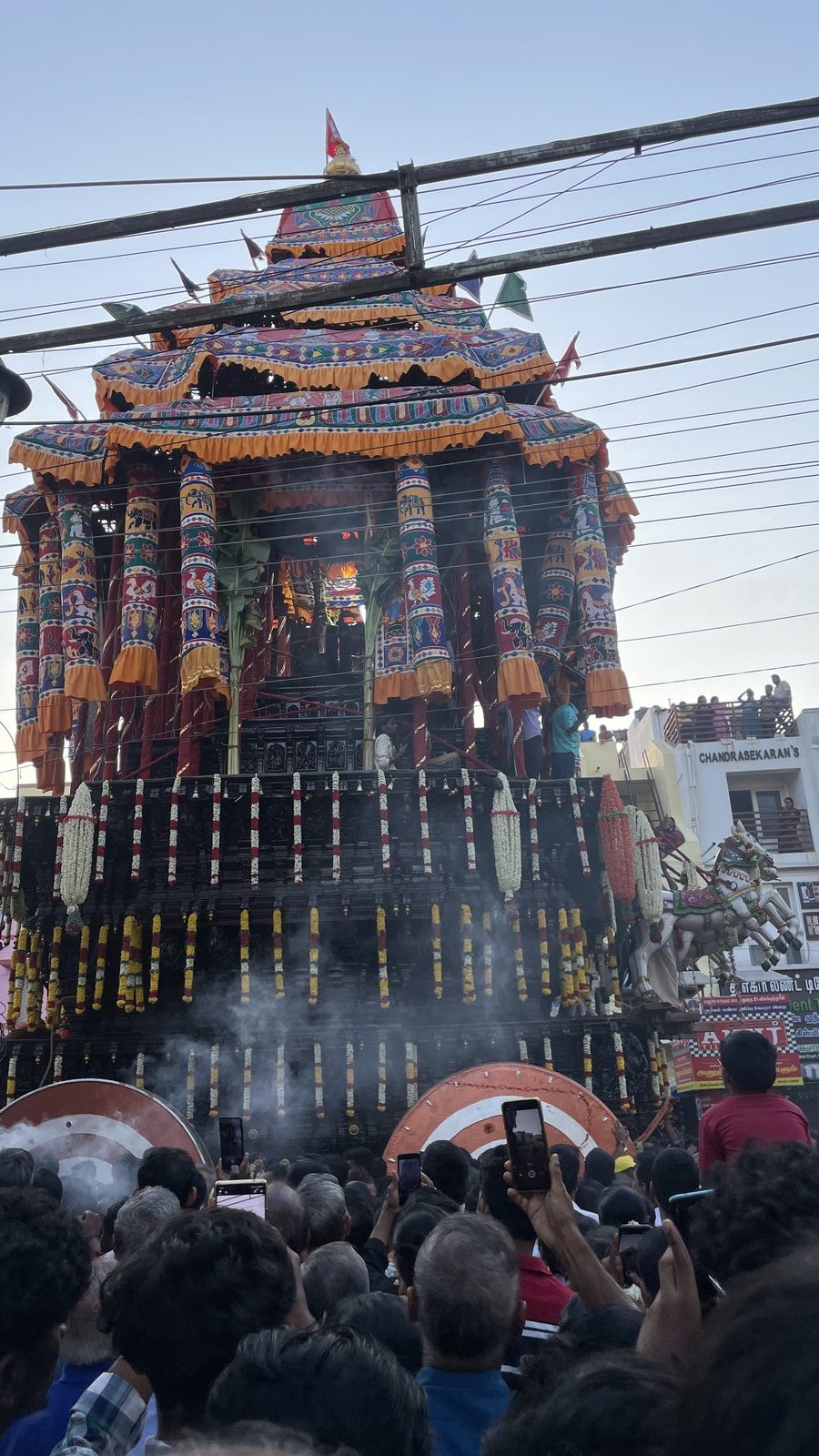
Chithirai is a 10-day celebration that tells the story of Goddess Meenakshi — the warrior goddess born of fire, the incarnation of Devi herself — her conquests, her encounters, and her celestial marriage to Lord Shiva. It is the story of Madurai, told in procession, in music, in ritual and in the extraordinary spectacle of the great temple cars moving through the four Masi Streets.
The emotional centre of the festival is the story of Lord Vishnu — known here as Lord Kallalagar, the Handsome One — who sets out from his temple at Alagarkoil to attend his beloved sister Meenakshi's wedding. He travels in great procession to the banks of the River Vaigai. But he arrives too late. The marriage has already taken place. And so Lord Kallalagar, unwilling to enter the city, turns back to Alagarkoil. His procession to the river and his return — this moment of divine disappointment, of love and dignity — is the most emotionally charged moment of the Tamil festival calendar.
Yes, it is hot — 38 to 42 degrees. But the pre-dawn hours and the evening processions are magnificent regardless. Those willing to embrace the heat will experience something no other time of year can offer.
The Float Festival — Teppakulam
In January, the Teppakulam float festival takes place at the vast tank adjacent to Meenakshi Amman Temple. The deities are placed on a flower-decorated float that drifts across the illuminated water while devotees line the banks. It is intimate, beautiful and far less crowded than the great Chithirai. For travellers who want a festival experience without the summer heat, Teppakulam is the answer.
Thiagarajar Aradhana — Nine Days of Carnatic Music in a Temple
In Thiruvarur, every year, the Thiagarajar Aradhana takes place over nine days in honour of the saint Thyagaraja — one of the trinity of Carnatic composers whose music defines the classical tradition of South India. For nine consecutive days, musicians and dancers perform on various themes, in the atmosphere of the temple, combining music, Bharatanatyam and devotional song into a continuous act of offering. This is not a concert. It is a sacred performance. Most visitors to Tamil Nadu never know it exists.
December in Tamil Nadu is the Margazhi month — considered the most sacred month in the Tamil calendar, the month when the boundary between the human and the divine grows thin. In Chennai, this translates into one of the world's great classical music festivals.
For a full month, hundreds of Carnatic music concerts take place across the city — in sabhas, in temples, in open-air mandapams. Legendary masters perform alongside young artists making their debuts. The repertoire spans the full range of the classical tradition. For music lovers, December in Chennai is as significant as the Salzburg Festival or Carnegie Hall. It is virtually unknown outside the Carnatic world.
Region by Region — The Answer Changes
Tamil Nadu is not small. The distance from Chennai in the north to Kanyakumari in the south is over 700 kilometres. The state contains high-altitude hill stations, a long coastal plain, an ancient river delta and an arid interior. Each region has its own best season.
| Region | Best Time | Why | Avoid |
|---|---|---|---|
| Madurai & the Temple Cities | Nov – Feb | Cool mornings for temple visits. Clear skies. Comfortable evenings for the night ceremony. | May – June (hottest months) |
| Rameswaram & the Coast | Oct – March | The sea is calm. The Pamban Bridge crossing is dramatic in clear weather. Pilgrimage season at its fullest. | Nov (northeast monsoon can bring heavy rain to the coast) |
| Kanyakumari | Oct – Feb | Sunrise is clearest. The three-sea confluence is at its most dramatic. October sunrise photography is exceptional. | June – August (rough seas, reduced visibility) |
| Chettinad & Karaikudi | Nov – Feb | Comfortable for walking between mansions. The dry air is pleasant. The banana leaf meals are best enjoyed without the summer heat. | April – May (very hot and dry) |
| Thanjavur & the Chola Delta | Oct – March | The agricultural landscape is green after the rains. Temple complexes are uncrowded. The river is full. | No truly bad time — this region is temperate year-round. |
| Ooty & the Nilgiris | March – June, Oct – Jan | March to June: pleasant hill weather, green landscape. October to January: cool and misty — ideal for tea estate walks. | Peak summer weekends (May) — very crowded with domestic tourists. |
| Kodaikanal | March – June | The lake is beautiful, the weather mild. The misty mornings on Coaker's Walk are extraordinary in April. | December – January (cold and foggy, lake views obscured) |
| Mahabalipuram & Chennai Coast | Nov – March | Cool sea breeze. The Shore Temple at dawn in December is extraordinary. Chennai music season in December. | November (peak of northeast monsoon on the east coast) |
A Note on the Monsoon
Tamil Nadu receives rain from both the southwest monsoon and the northeast monsoon — but they behave differently here than in the rest of India. The southwest monsoon (June to September) which drenches Kerala and transforms it into a lush green extraordinary landscape is considerably more modest in Tamil Nadu. The hills receive good rain; the plains are intermittent.
The northeast monsoon (October to December) is Tamil Nadu's primary rain season — arriving from the Bay of Bengal, it brings significant rains to the eastern coast. Inland, particularly in the Cauvery Delta and Chettinad, it arrives as welcome showers rather than disruption.
"In the resort properties of the Thanjavur belt — surrounded by paddy fields and river landscape — the rain gives an experience that the dry season cannot offer. The greenery, the sounds, the air after rain in an old Chola landscape is something particular."
For most visitors, the northeast monsoon is not a reason to avoid Tamil Nadu. The rain is largely manageable, the temperatures drop pleasantly, and the landscape after rain in the agricultural heartland of the Cauvery Delta is quietly beautiful in a way that the peak tourist season never quite matches.
Our Honest Recommendation
If you ask us directly — as our guests do — we give this answer:
For first-time visitors who want comfortable weather and the broadest experience: November to January. The temperatures are genuinely pleasant, the skies are clear, Chennai's music season runs through December, and the temples are magnificent in the cool morning light.
For the culturally serious visitor who wants to experience Tamil Nadu at its most alive: plan around a festival. Chithirai in April for the greatest spectacle; Teppakulam in January for the most intimate; Thiagarajar Aradhana for something almost nobody outside the tradition has witnessed; Margazhi in December for classical music at its most elevated.
For those who cannot choose their timing: Tamil Nadu is a year-round destination. Even in the hottest months, temple visits before 8am are comfortable and extraordinary. Even in the monsoon months, the hills are beautiful and the cultural sites are accessible. The season that suits you depends far more on what you want to experience than on the weather alone.
Common Questions
Timing your visit is only the beginning. Every journey we design is built around what you want to experience — the sacred, the ancestral, the musical, or all three.