Mahabalipuram
Pallava sculpture · Shore Temple · Descent of the Ganges · UNESCO World Heritage
The Pallava port — where stone carving had its first great flowering in South India
Mahabalipuram — Mamallapuram — was the port city of the Pallava kings, who ruled from the 3rd to 9th centuries CE from their capital at Kanchipuram. What they created here, in the granite outcrops along the Bay of Bengal, was the first great school of South Indian sculpture — a century of concentrated artistic experiment that established the visual language of Tamil temple architecture for the next thousand years.
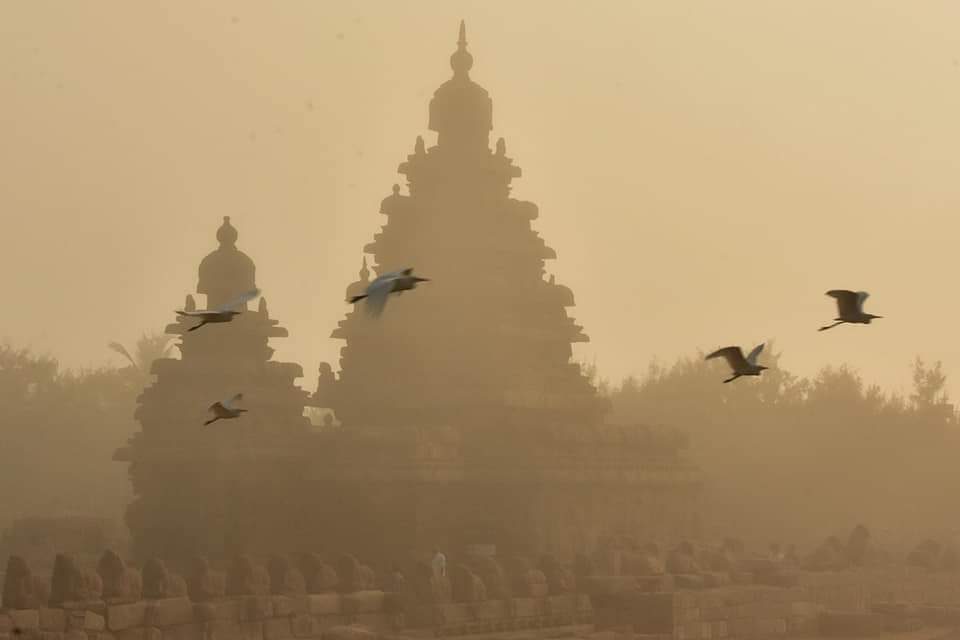
The Descent of the Ganges is 30 metres wide and 15 metres tall — the world's largest open-air bas-relief, carved in the 7th century with hundreds of figures in a single continuous composition. The Shore Temple stands directly on the water, the earliest surviving structural stone temple in South India, thirteen centuries of sea air visible in its eroded surfaces. The Five Rathas are monolithic experiments in architectural form, each one carved from a single granite boulder.
The quality of the sculpture here is exceptional — not merely technically accomplished but genuinely moving. The Pallava sculptors at Mahabalipuram achieved a naturalism and emotional range in stone that would not be surpassed in South Indian art until the great Chola bronzes three centuries later.


The detail that changes what you see
The Descent — Which Interpretation?
The great bas-relief has two principal interpretations. The traditional view identifies it as Arjuna's Penance — Arjuna standing on one leg performing austerities to receive the Pashupatastra weapon from Shiva. The alternative reading, now preferred by many art historians, identifies it as the Descent of the Ganges — Bhagiratha's penance to bring the river down from heaven to earth, with the natural cleft in the rock representing the river itself. Either reading, the composition — hundreds of figures participating in a single cosmic moment — is without parallel in world sculpture.
The Submerged Temples
An old tradition holds that Mahabalipuram once had seven pagodas, of which only one — the Shore Temple — survives above water. When the 2004 tsunami withdrew the sea briefly, local fishermen reported briefly visible stone structures offshore. Marine archaeological surveys have since documented carved stonework and structural remains on the seabed. The Shore Temple we see today is the survivor of a larger complex that the Bay of Bengal has been claiming for centuries.
The Five Rathas — Architectural Experiments
The Pancha Rathas were never completed and never consecrated. Each one demonstrates a different structural vocabulary: the Draupadi Ratha shows a thatched-roof form; the Arjuna Ratha a tower-and-vestibule layout; the Bhima Ratha a barrel-vaulted form derived from Buddhist rock-cut halls; the Dharmaraja Ratha a multistoreyed tower that prefigures the mature Pallava style. They are not temples in the functional sense — they are a builder's library, preserved because they were never finished.
The Living Sculpture Tradition
Mahabalipuram is still a working sculpture town. The sound of chisels on granite is constant around the Stony Shore area. Tamil Nadu's state institute of stone carving is here, and dozens of workshops produce pieces ranging from tourist souvenirs to museum-quality commissions. A conversation with a working sculptor — arranged through our guide — reveals that the technical knowledge of the Pallava tradition has been continuously transmitted, not reconstructed.
Krishna's Butter Ball — What It Actually Is
The large granite boulder that appears to rest impossibly on a smooth slope — known as Krishna's Butter Ball — is a natural geological feature: a rounded granite monolith resting on a polished incline, stable because its centre of gravity falls within its contact surface. According to a local account, the Pallava king Narasimhavarman attempted to move it with seven elephants and failed. The slope is steep enough that the optical effect is genuinely disorienting. It has been sitting unmoved for at least fourteen centuries.
When to Visit
October to February — after the northeast monsoon, before summer heat. The Shore Temple at sunrise, before the tour groups arrive, is one of the most composed views in all of South India: the granite pink in early light, the waves breaking at the base, the sky opening over the Bay of Bengal. November brings the Mahabalipuram Dance Festival, when classical performances are held against the monument backgrounds. December adds the warmth of post-monsoon clear air.
Visit Mahabalipuram with Exotic Destination
Based in Madurai since 2013. Our guides can read the sculptures — not just name them. A morning at Mahabalipuram with proper art historical context is a completely different experience.